What makes sense?
October 22nd, 2006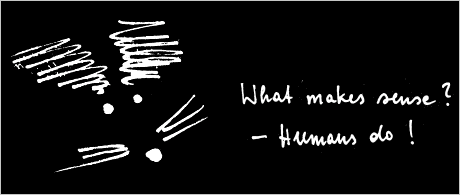
[What makes sense? — Ratta’s answer: Humans do!]

Und was haben wir daraus gemacht!

In case you are in need of de-dichotomization get yourself a De-Dichotomy Stamp, too.
We are each of us angels with only one wing.
And we can only fly by embracing each other.— Luciano de Crescenzo
Though, he did not mention that his was broken.
Me, I am no angel, I am just a common long-tailed rodent; each of my whiskers a wing, making my mind fly, embracing the world within.

Some say science is about truth. It is not about lies. What could science of science be? The truth about no lies? Says who? And do we know that it is the truth? Isn’t science also about questioning and analysis? Hence, what do we know about analysis of analysis?
Science “refers to a system of acquiring knowledge (…) aimed at finding out the truth” (Wikipedia, 2006-03-03). So we assume that knowledge is not truth. Probably that’s why to know is derived from “view”, as are “vision”, “witness” and the German “Wissen”. What do we know about knowledge?
No, not me. I am a liar.
I am trapped in a feedback loop. Please, don’t cut it!
Someone uttered: Stop making sense!
Being asked: What’s making sense?
I answered: We are.
And that’s where all the trouble and the fun started.
When we just started to grow up, when we are yet a little child and everything around us is still big, huge, high, and tall, we have no idea what a horizon is. As time goes by, we get taller and taller and we overlook a lot more of what’s around us. As we start to actually see a horizon we get an idea of what it is and where it might be. Eventually we grow older and the horizon moves away, far and further, into the distance. So far, far away that … one day we find it again, in ourselves.
Whatever this means, it came up listening to “The Horizon Has Been Defeated” by Jack Johnson, to be found on his great album “on and on”.
